
I recently had the chance to watch Mickey 17, which might have made me ask the question: Could a sufficiently advanced civilization build a living animal from individual atoms? Not grow one, not clone one, but assemble it directly, atom by atom, the way you might 3D print a chair?
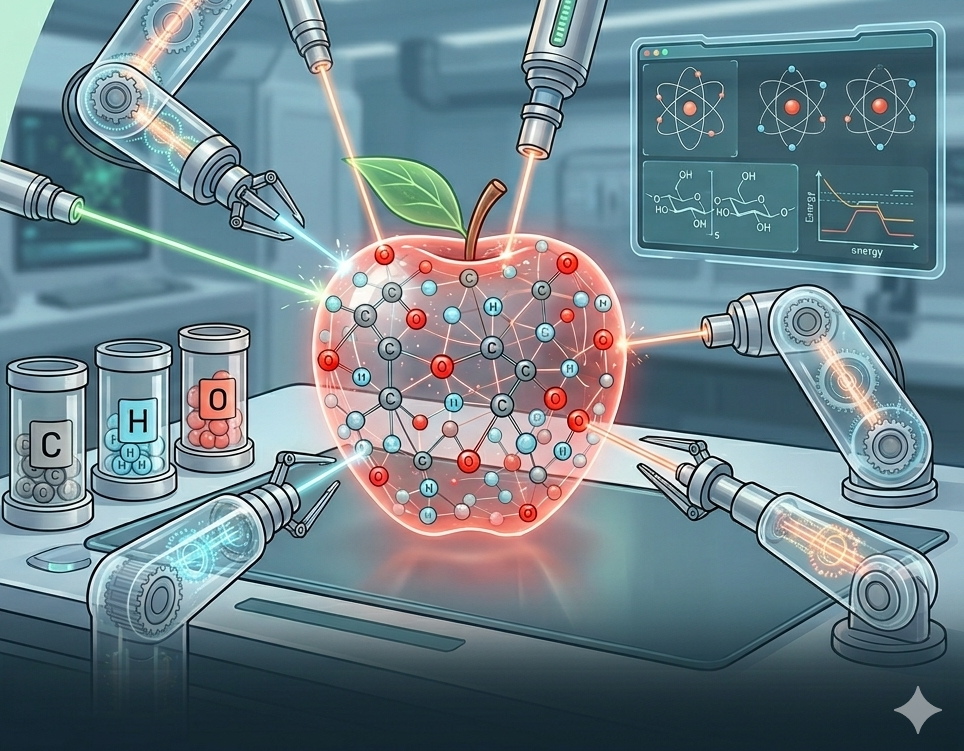
After some reserach I found the answer is more interesting than yes or no. The physics permits it. The engineering is the real question.
Atomic assembly is a solved problem in principle
The claim that atoms can be arranged into any stable configuration is no longer really a hypothesis. It is a demonstrated capability that we are progressively scaling up.
In 1989, IBM scientists used a scanning tunnelling microscope to position 35 individual xenon atoms one by one to spell “IBM” on a nickel surface. By 2016, three chemists shared the Nobel Prize in Chemistry for designing molecular machines, controllable devices a thousand times thinner than a human hair. And nature has been doing precise atomic assembly for billions of years through ribosomes, the molecular factories that build proteins, one amino acid at a time, following templates encoded in DNA.
The principle is settled. What remains is a question of scale, precision, and information. An apple contains roughly 10²⁵ atoms. A mouse contains a few orders of magnitude more. Specifying their positions and bonds is an enormous data problem, but not a physical impossibility.
So an apple is, in principle, achievable. A mouse is where things become much more difficult.
Why a living animal is harder than an apple
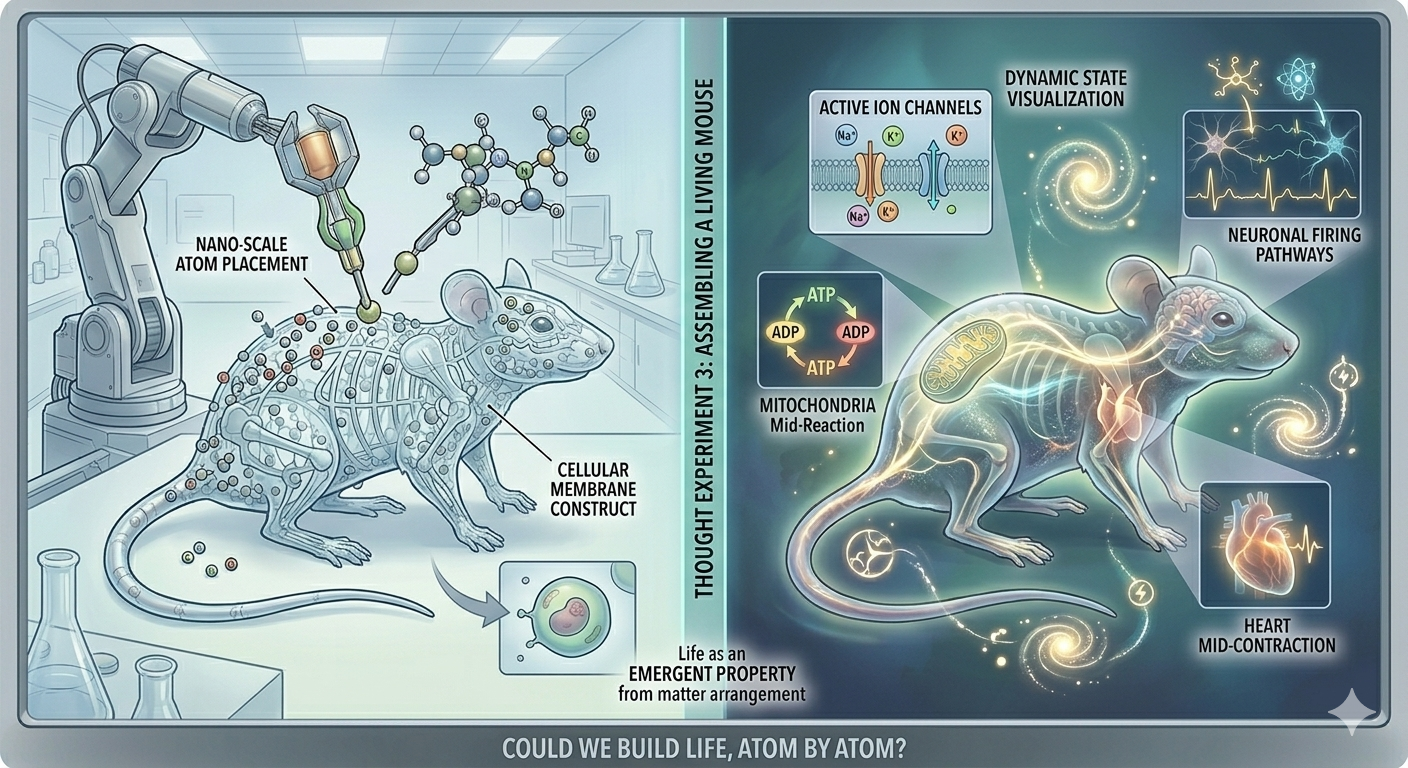
An apple is a static structure. A living mouse is not.
A living cell and a freshly-dead cell contain almost the same atoms in almost the same arrangement. What separates them is a dynamic state: ion gradients pumped across membranes, ATP being broken down for energy, enzymes mid-reaction, neurons mid-firing, the heart mid-contraction. Life is a process, not a configuration.
This means atomic assembly faces a problem that has nothing to do with putting atoms in the right places. If you froze a mouse and reconstructed its frozen state atom by atom, you would have a frozen mouse. Thawing it would not bring it back. Thawing reconstructed tissue is well known to be fatal because ice crystals destroy cellular membranes, and the chemistry of life cannot simply restart from a static snapshot.
To assemble a living mouse, you would need to specify not just where each atom sits, but what it is doing at the moment of assembly. The reaction, it is in the middle of. The membrane potential it is helping to maintain. The protein it is part way through synthesising. This is a much harder specification problem than capturing structure.
The realistic path: synthetic biology
Atomic assembly is theoretically possible, but synthetic biology offers a far more practical route.
In 2010, Craig Venter’s team built a synthetic bacterial genome from scratch. More than a million base pairs of DNA, chemically synthesised, then inserted into an emptied bacterial cell. The cell started up and began reproducing. The operating system was synthetic. The hardware was borrowed.
Since then, the Sc2.0 project has been synthesising the chromosomes of yeast, a eukaryote with 12 million base pairs across 16 chromosomes. The remaining hard step is building a functioning cell from non-living components. This has not been done. Cells are extremely complex self-organising systems, and assembling one from scratch is currently beyond reach. But once a synthetic cell exists, developmental biology takes care of the rest. From a single cell, an entire animal can grow through the same processes that turn a fertilised egg into an adult.
So the realistic path to building an animal is not direct atomic assembly. It is:
synthesise a genome → install it in a synthetic cell → let development do the rest
This is the most likely route, if it ever happens.
What synthesis cannot answer
Suppose all of this works. We grow an animal that is indistinguishable from a naturally-born one in every measurable way: same behaviour, same neural patterns, same physiological responses.
There is one question this would not settle. Is the resulting animal conscious in the way naturally-born animals are conscious? This is the so-called “hard problem of consciousness”. We can map every neuron and observe every chemical reaction, but we cannot directly detect whether there is any subjective experience on the inside. A perfectly-built mouse might or might not be a philosophical zombie: behaviourally identical to a born one, but with no inner experience to speak of.
Most scientists working in this area assume consciousness emerges from physical organisation, and that a properly-built brain would experience things just as a born brain does. But this assumption is not testable from the outside, no matter how much progress we make in synthesising bodies.
References & further reading
- Eigler, D. M., & Schweizer, E. K. (1990). Positioning single atoms with a scanning tunnelling microscope. Nature, 344, 524-526.
- The Royal Swedish Academy of Sciences. The Nobel Prize in Chemistry 2016 (Press release).
- Gibson, D. G., et al. (2010). Creation of a Bacterial Cell Controlled by a Chemically Synthesized Genome. Science.
- Sc2.0: The Synthetic Yeast Genome Project.
- Stanford Encyclopedia of Philosophy: Consciousness and Zombies.
- Wikipedia: Uncertainty principle, Ribosome.
Researched and drafted with assistance from Claude. Images were generated using Gemini.
 Thilina
Leave a comment